Pages

Showing posts with label Boeing. Show all posts

Monday, March 7, 2016

Leading Special Projects

Teams utilize many different talents
(courtesy 2013.igem.org)


Leading a operations team is an experience everyone should do as often as the opportunity arises. Some people always look for leadership possibilities and thrive on nearly every task they manage. Others think they are leaders and quickly prove to everyone around them that they have no clue as to what is going on and how to get the most from team members.  Still a third group seeks to avoid leadership opportunities and is content to be a role player.  To be an effective leader on a special project that requires fast answers and execution, here are a few tips:


  • Utilize the group's strength.  Early in my career on Boeing's portion of the F-22, I was tasked to lead a team of engineers and operations folks to help build a test box for a live fire test to ensure survivability for the wing.  Since the first test failed miserably there was a high level of concern to get the right answer quickly. During our meetings to plan our next test, I utilized the members of our team by engaging them in conversation about all engineering, manufacturing and operations parameters.  They were far more experienced than I was at the time, so it would have been foolish of me to try to "fake" my knowledge.  Instead I let the experts help guide us to the optimum solution and I served the group as a facilitator.  The next tests were ultimately a success and the program passed an essential milestone for survivability.
  • Do what is necessary for success.  This seems obvious but many people feel that they only need to do their assigned tasks and let others do theirs.  Sometimes others get pulled away onto something else, have trouble executing, or simply just don't have a sense of urgency for a special project.  Then you have to forge ahead and do what they haven't done.  I did this one time in my Boeing career when I had to do layouts of an area another engineer was supposed to perform.  He kept procrastinating the job until it was getting close to jeopardizing the program.  I stepped in and started the job.  It caused some conflict with him but the job had to be done.
  • Give credit to those who help.  Often during a busy project, you have to ask people to go above and beyond what is expected of them.  This includes after hours and weekend work to get the task done.  At the least, you can send them a thank you note or let their manager know how much they helped you.  It is the right thing to do and helps ensure they will be willing to help you again in the future.

(courtesy agilebacon.com)


Wednesday, February 10, 2016

Transferable Skills


(Courtesy keithparnell.com)


With many out of work or looking to find a better position, it is one of the busiest hiring periods in recent times. Those working in Human Resources (HR) know all too well that the sheer volume of resumes for just one position can reach well over one hundred resumes.  So in order to narrow the possibilities, the HR professionals word the job posting so that no one really has all the "minimum qualifications" that the hiring company is seeking to find.

Not to be overlooked are transferable skills.  Here are some of the common mistakes found in hiring and what fixes the issue:


  • "No experience in our industry".  I was once told I didn't have any food industry experience for a manager's position at a local yogurt plant.  What I did have was many years experience in a manufacturing operation.  My experience was in a regulated industry (FAA) that is comparable to another regulated industry, food manufacturing (FDA).  So the skills I learned at Boeing (management, dealing with machines that go down, raw material issues, etc) are transferable to other manufacturing industries.  In fact an outsider may very well bring fresh new insight to the position.  In addition, the learning curve is not so steep that an experienced person can quickly get up to speed.
  • "You aren't experienced in our 3D CAD system".  If you have had any training in one  3D CAD system, you can easily learn another.  The commands for doing operations are different but make sense once you get into the nuts and bolts of the CAD system.  In fact with many icon based programs like CATIA V5, all that is required is to know the icons.
  • "You have never been a manager before".  Maybe not but every manager out  there was working at a staff level before being promoted.  They were not managers before either.  Many managers join a company with preconceived ideas on how things should be run in the new company.  Often it is better to take an inexperienced face and  mold that person into the leader your company deserves.


(courtesy:csuitementor.com)


Wednesday, January 13, 2016

Points of Contact


(Courtesy: tidigitalsoltion.it)


In any operation it is essential to know who is the contact person in a different group than your own.  The bigger the company, the more important it is to know who to go find if you need help or have a question.  Otherwise you can spend many hours calling and asking around to find an answer to your question.

One of the best work features Boeing used was a making a points of contact list available for groups. Many work tasks or projects were  often specialized by one or two key individuals within a group.  These subject matter experts (SMEs) would often be the best sources for information available to others within a group.  So it benefited the entire organization to have contact information published in an easily accessible place, usually online.  If you had a question particular to that topic, all you had to do was call or e-mail the expert and could expect an answer in several hours at most.  Effective  groups would make sure the points of contacts name an contact information was current, since many people often shifted work assignments.

(Courtesy: www.greetvectors.com)


I have also been in groups where there is no contact information published.  It is extremely frustrating and time consuming to have to try to find  the right person to talk to.  Many people often gave up in their search and would simply try it on their own.  Not a good way to run a business!

Monday, January 4, 2016

5 Whys


(Courtesy: www.startofhapiness.com)


The hardest part of fixing a problem is usually the root cause analysis.  It is the "Why?" that so many operational leaders and engineers fail to ask once a problem becomes apparent.  Instead they jump to the "How to fix it" step.  This is like treating the symptoms instead of identifying and correcting the cause of the issue.


The 5 Whys is a systematic approach to root cause analysis
(courtesy: www.presentationeze.com)


Fortunately using a structured root cause analysis, the 5 Whys method is what can quickly get you to identify the cause of the issue and take the necessary corrective steps.  It is simply a cause and effect diagram, Pareto chart or any other type of graphical representation.  Starting on the left side of the chart, you ask the question, "Why did this problem happen?".  You then answer the question to the best of your ability.  You keep asking "why?" until a root cause is determined.  It may no take asking Why 5 times (hence the title).  You may find an answer in 2 or 3 Whys.  But it forces you to dig into the analysis and really understand what happened and not just assume you can fix the problem.


An exmple of 5 Whys:

(Courtesy: leanman.hubpages.com)

One of the biggest problems I faced at Boeing was a high number of passenger seat  rejections on the 787 program.  After starting a formal root cause analysis program involving the entire operation, we determined there was not enough engineering checking in the process.  We recommended that management approve a more rigorous  checking process to help catch the errors earlier rather than later.  However the management  said this would be too costly and didn't approve the recommendation.  

So even though management's view  was short sided, the tools are valuable to really get to the heart of the issue. It can save a great deal of time and money if everyone is on board and understands what is going on.

Thursday, November 19, 2015

Prototype Shop


(Courtesy www.rpmaustin.com)


When you need quick turnaround for manufacturing operation it is often impossible in the normal flow of operations.  You may have experienced a delay in materials, a last minute design or repair change that necessitates the urgency of accelerating a part through the manufacturing process.  That is why you need a prototyping shop.

At Boeing it was referred to as "blue streak" shop named after its color code in the manufacturing operation.  The shop was usually a small area in the factory that had small drill presses, lathes, and other required equipment that could do 1 -2 small jobs at a time in a hurry.  The machinist or mechanic in the blue streak shop was an experienced person with at least 20 -25 years experience.  This was helpful not only for utilizing his or her machining skills attained during that period, but also to tap into how to best plan and execute a machining operation in fast order.

Utilizing experienced, skilled machinists can help you in a time of crisis
(Courtesy wwwinvestcastinc.com)

Granted smaller companies may not have the luxury of dedicating their top machinist to a prototyping shop.  But with careful planning and coordination, an urgent job can be seamlessly scheduled within everyday operations so as not to disrupt the entire operation.

Wednesday, November 4, 2015

Self-Directed Work Teams


(Courtesy of www.blog.commlabinda.com)


In an earlier post I discussed integrated product teams which are cross-functional teams composed of members of different  skill sets all focused on developing a product or improving a process.  Another kind of effective team is the self-directed work team.  A self-directed work team may be cross-functional in membership.  Or it may contain mostly members from a single functional group or organization.

A self-directed work team is a team which can operate autonomously to identify problems or areas needing improvement, outline plans to solve the issue, and proceed to implement the plans to a successful conclusion.  These teams do not require constant monitoring by management.  If fact they perform much better if management "stays out of the way".  It's not to say management should not be briefed on what the group is doing and a timeline for completion  - they should be aware.  It's really a fact that a self-directed team knows how to work without being told what to do.

One of the teams I worked on at Boeing was a self-directed tooling team that solved various tooling issues related to F-22 fighter airplane manufacturing.  It was a team made of experienced design engineers as well as new engineers out of college.  They common thread was that everyone on that team wanted to make the program better and worked hard to reduce costs, improve flow, and steam line operations.

One incentive to encouraging aspirations to developing a self directed work team is to set up standards for different levels to work teams.  Start at criteria for a  Level 1 self-directed work team and list completion criteria for this level.  Keep going up to say a Level 4 which would be the most complete and autonomous work team.  Provide incentives to teams to reach a Level 4 and you will find that more employees will work to improve their effort without a lot of management oversight.

A good article on self-directed work teams is here:

http://www.qualitydigest.com/magazine/1995/nov/article/self-directed-work-teams-competitive-advantage.html#

 A self-directed work team working an issue
(Courtesy www.ctspring.com)


Friday, October 16, 2015

Experienced Workers in New Positions


(Courtesy www.islinguists.com)


One of the benefits of hiring an experienced worker is you can expect him or her to be able to ask the right questions, look for answers on their won, and generally find out how to do their job without a lot of oversight.  However if a person is hired to your organization based not as much on direct experience but on common, transferable skills, it  is essential that there be some allowance for learning for the new position.

From personal experience, I have had this happen to me.  I was hired as an experienced engineer at Boeing to help out a group.  However the new group's task (passenger seat integration) was new to me and required some initial learning and mentoring that I never received.  Needless to say my experience was not a pleasant one and I eventually left the group.

Here are some ideas to integrate an experienced worker into a new role:


  • Find out how much experience he or she has in the new area. Then fill in the gaps with classes, training, and mentoring to get that person up to speed.  It shouldn't take long for an experienced worker to grasp the new details so this is time well spent.
  • Get feedback from the new worker.  Sometimes managers (especially younger managers) are reluctant to talk to a seasoned worker.  Get over it.  Your organization's success depends upon the solid performance of it's workers.  Let them know you care.
  • Find out what areas the worker excels at and give them projects that showcase those skills.    They can help your organization by tapping on previous experience while learning the new job at hand.  


(courtesy: www.cochrenfoundation.com)


From an engineer's perspective it is important to know that while many skills are transferable there may be gaps that need to be filled in.  Don't just throw someone into the deep end of the pool and hope they know how to swim.


Monday, August 17, 2015

Engineers on the Shop Floor


(a Boeing 747 being assembled - courtesy of hotcharchipotch.wordpress.com)


In an earlier post I explained how it is essential to have the base of engineering operations as close to the manufacturing operations as possible.  In a ideal case, would be to have the engineering and manufacturing in the same building or in buildings next to each other.  Proximity to one another is what makes a successful operation.

But it is not enough for engineering and manufacturing to be near each other.  The organization must make an effort to encourage (hopefully not force) engineering to spend time on the factory floor.  There they can learn about how different stages of the operation work and can spend time talking to mechanics to learn what their challenges are in fabricating and building parts.  At Boeing (and at other large companies I would assume the same), young new hire engineers often do not want to visit the factory and learn.  Because of organization attitudes they are led to believe that engineers design the product and "throw it over the fence" to operations to build.  Not very efficient.

On of the best ways to get engineers to engage the factory is to put them in a liaison engineer role.  The liaison engineer is a degreed engineer who is works on the factory floor and helps bridge communication between engineering design and  manufacturing.  Often the liaison engineer has authority to repair parts damaged during manufacturing which expedites operations immensely.  At Boeing I was a liaison engineer for a little over a year and that experience made me a better design engineer by learning how to design a part that could more easily manufactured and later installed in the aircraft.


(Engineers on the factory floor)

I served as a liaison engineer later in my career and would advise organizations to schedule the new hire engineers to rotate as a liaison engineer after 1 - 2 years design experience.  An early exposure to shop practices will make them better design engineers which improves the entire operation.

Monday, August 10, 2015

Rapid Prototyping

Rapid Prototyping serves a fantastic role in the product or service design stage within operations.  Historically a designer would do the best job possible in identifying areas of concern prior to releasing a design to be fabricated.  Once the design was released it usually went into fabrication and (with fingers crossed) everything went well.  If not there would be a revision to the design and the process started over and more finger crossing.

With the advent of rapid prototyping, it was easy and fast to create a first look at a design before it went into production.  All the designer has to to is send a 3D CAD model to the prototyping shop.  Then the programmers would write the program and have the part "built", often using stereolithography to produce it.  Then the part can be inspected by all concerned parties and any modifications can be done quickly.  This means it can then be implemented quickly in time to support a tight production schedule.

During my time at Boeing, I was fortunate to have visited the rapid prototyping shop in South Seattle.  They could take any complex design and fabricate it to reveal what the part would look like.  It was fast and the results were amazing.


These two chess pieces were made at a rapid prototyping shop.  The grey piece made from a steel alloy and the red piece is made from a plastic.  Notice the detail on the close up of the red piece below.


The popularity of 3D printing may eventually take the place of a prototype shop.  But until everone has a 3D printer, it is worth the time to use a rapid prototype shop to prevent design delays during a critical part of the operations flow.

Wednesday, August 5, 2015

Plant Audits

Arriving at a supplier's plant to audit the operations process is an activity that causes much anxiety for the supplier (at least the first couple of times).  Generally it is done when there are problems identified in the flow of operations.  There may be office related (i.e. engineering) or  production related (i.e. manufacturing).  Both areas must be addressed.


(Courtesy: www.pooltechservices.co.uk)


An engineering audit may uncover errors in design.  I have audited several supplier's while working at Boeing.  One supplier had a different type of CAD software than Boeing was using (that in itself was a problem).  This particular supplier had several issues with the 3D models that the Boeing team helped uncover that might have been missed if not for the audit.

All specifications and inspection criteria must clearly be flowed down from the prime contractor to the supplier.  I saw this issue happen during the same audit trip and this time it was Boeing's fault that the correct specifications were not imparted to the supplier.

It's also valuable to ensure that the supplier's engineering team is in sync with its manufacturing team. You can usually tell how this relationship is going during a kickoff meeting day one of your plant visit.  If relations between the two appear distant or aloof, then there is trouble.

For the manufacturing side, all aspects of the process are reviewed.  Do the machines break down often?  If the break, how long is the downtime?  Are the mechanics and machine operators properly trained?  What are the specific training plans for each operation?  Is the layout of the plant optimized?  All questions that need answers.  And that is just the start.

Some people are afraid to respectfully challenge the supplier.  During my audit trip, one of my fellow Boeing engineers continually challenged the supplier about all aspects of production.  He did it in a polite but assertive manner.  But the supplier eventually got tired of him and later told him he was not welcome back to the supplier's plant.  That engineer eventually became a Boeing manager because he embraced due diligence in seeking to make the operation more efficient.


Typical Supplier Manufacturing Plant - courtesy www.logicpol.com)


Sunday, August 2, 2015

Real World Use of Statistical Process Control (SPC)


(Courtesy: wallpapers-xs.blogspot.com)


If you read many books on lean six sigma, you quickly realize that much of the focus is on data collection and analysis.  If you are like me you wonder if there are any real world applications and how can using the data collection techniques improve a process.

Early on in my earlier life as a design engineer at Boeing, I was part looking into a tolerance study of stringers on the B-2 bomber program.  These stringers were attached inside the wing and serve to transfer load from the wing skin to the underlying frames and ribs.  There were issues with the location of the stringers being out of position and our engineering group sought to determine why the stringers were out of position.


A generic configuration showing the long slender stringers as they sit in a wing box - courtesy of avcom.co,za 


We took location measurements of where the stringers were actually resting on the wings stored in the factory.  We then used the +/- tolerances as the upper control limits.  We then gathered data and plotted the stringer locations as measured to try to determine if there were any significant common trends (i.e. at a particular stinger number, at  certain coordinates in a wing, etc.)

Unfortunately I left that group shortly thereafter and I lost track of the final outcome.  At that time six sigma was not nearly as accepted as today, so I don't think we even knew what else to do and how to go into much greater analysis.  But I gained a quick indoctrination into six sigma and know it can show how to improve a process or product if used effectively.


Monday, July 27, 2015

Technology in Operations

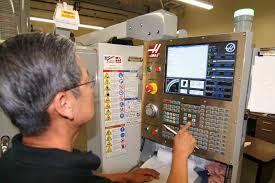
The importance of technology in operations cannot be overstated.  Now the norm rather than the exception, numerically controlled (NC) machines can consistently produce complex designs  in fractions of time that a person (or two) can complete the job.

Typical machining operation


NC machining has it's challenges.  An NC operation must be defined by an NC programmer.  It is is paramount that the NC programmer be sufficiently skilled and experienced to accurately program the correct steps required to complete the task.  A thorough check (and possibly trial machining pass) be performed prior to working on a production part.  In my time at Boeing there were several instances where the NC program erred and cost valuable time and money.  One such instance involved a composite tape-laying machine that was incorrectly programmed.  The head of the machine drove into a composite wing and created a gouge 0.5 inch deep.  Repairing the panel required many hours (and significant financial resources) to bring the wing back to conformance.

There are also other issues.  Obviously machines break down occasionally due to high usage.  A good maintenance plan will eliminate most problems.  But when a machine breaks down, it's best to have a qualified and available person(s) available to fix the issue.  This is a good argument for owning an older model machine and not the latest version.  There is a lot of history and knowledge with older machines and this helps speed the repair process if outside consultation is required.

Of course an operation needs qualified machinists/operators to run the machine.  More importantly the machinist has to know at a moment's notice to stop the machine if something appears wrong.  Bringing new people on board to an operation should include a transition where the experienced operator will help guide the new operator through the process.


Manual NC programming


Saturday, July 25, 2015

MRP and Bill of Materials

A key component of operations management focuses on the material requirements planning (MRP) system.  Materials and processes must be available at the appropriate time in the manufacturing sequence in order to build the part in time to support schedule.  Defined in the bill of materials (BOM), the "ingredients" for building the part is listed in the MRP system for anyone who needs to reference it.


( A simple chair BOM)


A big challenge comes when the part is fabricated at a supplier, far from the home base of operations.  During my time as a engineer with Boeing, there were several instances where the raw material listed in the BOM was not available. Occasionally the supplier who built the part was not able to obtain the listed material.  If no equal substitute part was called out in the BOM, this presents a problem.  If no one  can deliver the required material, the supplier will try to get a new form of material added to the BOM at the last minute in order to keep the production line moving.  A new form may required some testing, and will certainly require a handful of experts to evaluate whether it is acceptable to substitute the new material form.

The problem is that even though a supplier may have not ensured it's provider of raw material can meet the demand, it now becomes  the prime company's issue to approve the new material form and do so in a hurry.  I have been through several fast changes to the BOM, which take awhile to do in a large company.  It creates a great deal of anxiety and stress.

The takeaway from this is to ensure your supplier has enough of the raw material that is required from the BOM, and have a backup material in case  there are material shortages.


Thursday, July 23, 2015

Importance of 5S in Operations

 The 5S system of organization developed by the Japanese consists of 5 steps all starting with the letter "S":


        1. Sort 
        2. Systematic Arrangement ("Set")
        3. Shine ("Sweep")
        4. Standardize
        5. Sustain


 A great explanation can be found on Wikipedia along with other websites:

5S methodology from Wikipedia


I used this system when I worked at Boeing and saw how efficiently it improved operations. (I put the quotation marks around the terms as I used them at Boeing).  We used the 5S system both in the office and in the factory.

Using it in the office I noticed a little improvement. Many of the excess file cabinets, folders, etc. were eliminated by a "sort" and this did much to clean up the office.  However over time the other four steps were not followed consistently and the effectiveness of the 5S methodology diminished.

The factory operations had much better success.  I noticed that many of the tools used by the mechanics were mounted in boxes in easy to reach places (the "set" part of 5S).  As the tools were removed for use, you could see an outline of the tool painted in the box . Upon returning the tool, the mechanic could easily see where to put the tool  - much like placing a puzzle piece into a puzzle. This was especially valuable when many tools were being used at one time.  There was also a label describing the tool to ensure the correct tool was in its proper place. Regardless of the tool size the system was used and allowed a much more efficient operation. This is especially valuable because in building an aircraft you can't have unaccounted tools which could be left inside an airplane being assembled.


(Photo courtesy of leanblitzconsulting.com)


It didn't stop there. After each shift (and when required) the mechanics would literally "sweep" the floor and"sort" their work area of unwanted materials.  This became a regular expectation of the mechanics and helped to ensure the success of the "sustain" element of 5S.  I don't know how much the 5S system saved the factory.  But I did notice how  organized and efficient it became thanks to the mechanics would committed themselves to 5S.


Tuesday, July 21, 2015

Integrated Product Teams

Historically functional groups such as design, tooling, quality assurance, manufacturing, and others have tended to operate with their own circle.  For instance as a  design entered the functional group for evaluation, it was reviewed and then comments were passed back to the originating group (usually design).  The process iterates until everyone is pleased and then the design is moved to the next functional group and the process continues.  An extremely time-consuming process.

My best experience in avoiding this was working in an Integrated Product Team (IPT) as an engineer on the F-22 fighter program for Boeing.  In an IPT the structure is focused on a product rather than a function.  The IPT I worked in (Internal Spars) had members from design, stress, tooling, quality assurance, and manufacturing sit together to develop a superior design concurrently.  


As a design was developing, each functional member could provide immediate input to ensure the design was optimized while it was being designed rather than after the first iteration was completed.  It was a refreshing way to design a product and highlighted several benefits:


  • Decreased design time as all functional members were able to contribute while the design was being developed.  Feedback was incorporated immediately and  design was able to progress more rapidly to completion. It was immediately evident that operations would be improved by working together from the beginning.
  • Working together with other functional group members allowed me to understand what was important to them.  I had previously thought of other functional members as "them" but working in an IPT made me think of "us".
  • In an IPT I was able to understand the entire design build process as I was involved in all phases of it, not just the design process.  I have used this experience in subsequent design activities to make me a better engineer.


(Typical IPT example)